Technological Innovation Drives the Upgrade of Recycled Leather Manufacturing
Advanced technologies are bringing new momentum to the recycled leather industry. In recent years, as environmental requirements have become stricter and the circular economy has gained wider attention, the reuse of leather waste is no longer limited to traditional crushing, mixing, and pressing processes. Instead, the industry is moving toward digital manufacturing, automated production, and high-performance material development.
In Europe, the ECOFAP project is exploring the development of leather waste into new materials suitable for 3D printing, with applications in customized footwear manufacturing. The project focuses on processing leather residues and combining them with polymer materials to create composite materials for additive manufacturing. This provides new possibilities for producing customized shoe soles, heels, and other footwear components. According to related reports, the ECOFAP consortium includes CTCR, AIMPLAS, Grupo Pikolinos, and Evatalking, and the project aims to turn tanned leather waste into printable material for footwear applications.
This innovation shows that the value of recycled leather is being redefined. In the past, leather scraps were often regarded as low-value waste. Today, through crushing, fiber opening, material modification, and digital manufacturing technologies, these materials can re-enter the production system and become valuable raw materials for footwear, bags, decorative panels, industrial boards, and other products.
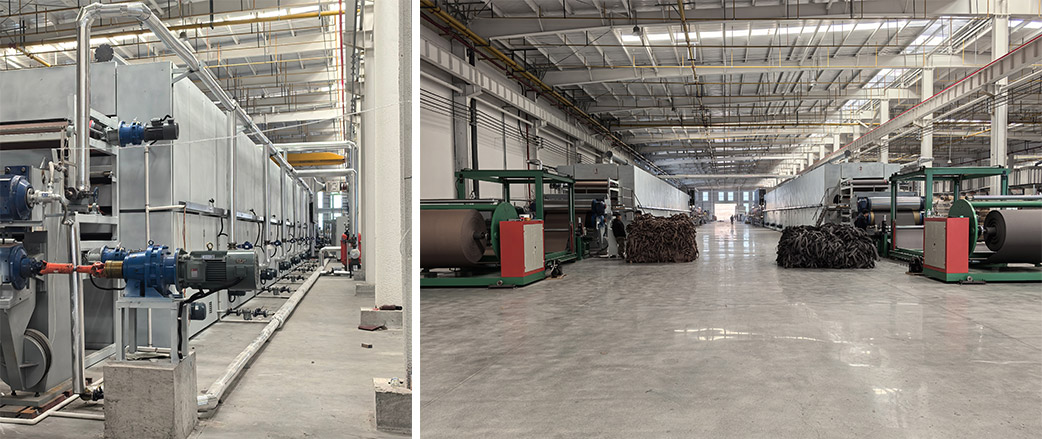
In addition to 3D printing, automated equipment is also accelerating the upgrade of recycled leather manufacturing. Modern recycled leather production lines usually integrate crushing, fiber opening, dust separation, mixing, bonding, laying, and hot pressing processes. This makes material processing more continuous, stable, and controllable. With automated equipment, manufacturers can improve production efficiency, reduce manual operation errors, and enhance product consistency.
In the raw material preparation stage, leather scraps are first processed by a coarse crusher, which cuts large waste pieces into small and uniform fragments. These fragments are then further processed by a fiber opening machine, which loosens the leather fibers into fluffy fiber tufts. After sufficient fiber opening, the material can be mixed more evenly with adhesives, fillers, or other fiber materials, providing a stable foundation for the following pressing and forming processes.
At the same time, energy efficiency and environmental protection have become important directions for equipment upgrades. High-efficiency motors, optimized cutter rotor structures, cyclone dust separation systems, and centralized dust collection devices can help manufacturers reduce energy consumption, control dust emissions, and improve the overall stability of the production line. For recycled leather manufacturers, equipment is no longer only a processing tool, but also a key factor in improving product quality and environmental performance.
Looking ahead, as new material technologies, automation control, and green manufacturing processes continue to develop, the recycled leather industry will gain broader application opportunities. From traditional recycled leather boards and rebonded leather to new composite materials for footwear, bags, and home decoration, recycled leather is gradually moving from a low-cost substitute material to a higher-value industrial material.
For manufacturers, keeping up with international technology trends, upgrading production equipment, and optimizing raw material processing methods will help strengthen competitiveness. The future of the recycled leather industry depends not only on the recycling value of the material itself, but also on whether manufacturing technology can transform leather waste into stable, attractive, durable, and commercially valuable new products.